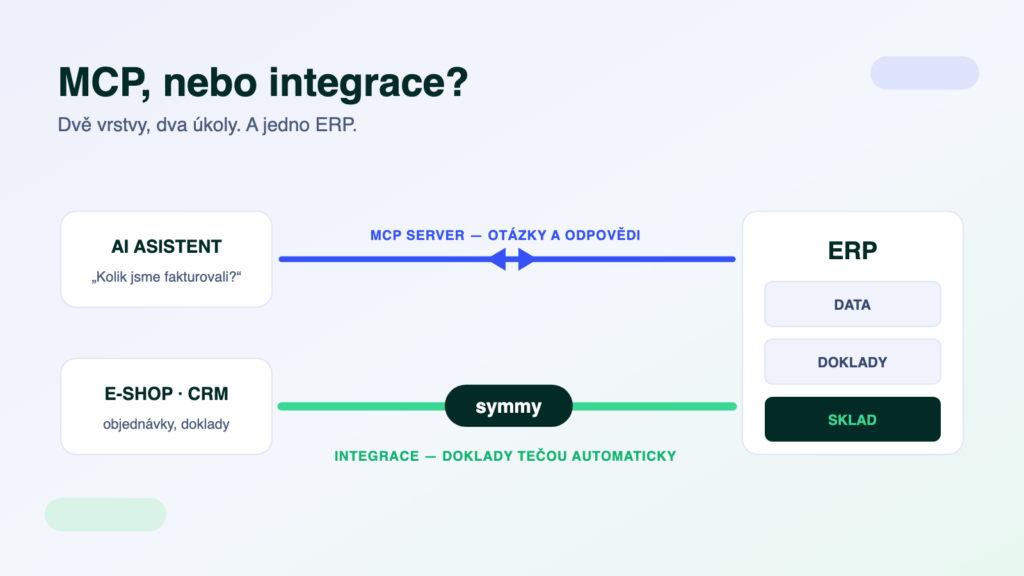
“Should we be looking at an MCP server, or a classic integration?” We hear this question in meetings more and more often — and it is asked slightly backwards. MCP and integrations don’t solve the same problem, so they don’t compete. This article compares what each one does and gives a practical guide to when to reach for which.
The short answer
An integration connects systems to each other — e-shop orders flow into the ERP on their own, every few minutes, with no people involved. An MCP server connects people to the ERP (through an AI assistant) — question, answer, right now. An integration replaces retyping data; MCP replaces waiting for reports. Most companies end up needing both, but they start with whichever hurts more.
Same data, different job
- IntegrationRuns continuously in the background. Moves documents and data by rules: orders, invoices, stock, price lists. The outcome is that the systems understand each other on their own — nobody retypes anything.
- MCP serverWaits for a question. “How much does Novák owe us?” “What has been sitting in stock for over a year?” The outcome is an answer from live data in seconds — no exports, no waiting for the accountant.
- IntegrationIs measured by reliability: how many documents went through, how many errors, how fast. The typical parameter is the interval — from a minute to several times a day.
- MCP serverIs measured by how useful the answers are: how many questions the team now answers itself, how many reports nobody has to compile any more.
When to start with an integration
When your pain sounds like retyping: e-shop orders are entered into the accounts by hand, the stock levels on the website don’t match reality, invoices are copied between systems. That is a job for a classic integration — you build it once and it then moves data on its own for years. You’ll find specific system pairs in our integration catalogue.
When to start with an MCP server
When your pain sounds like waiting for an answer: management wants numbers, the accountant compiles reports instead of doing the books, sales asks about stock over the phone. An MCP server connects an AI assistant to the live data in your ERP — you start read-only, with no changes to the system, and you have your first answers the same day. Running it starts at 2 490 Kč a month, an order of magnitude less than building an integration — because nothing is being built, only made accessible.
Three scenarios from practice
- An e-shop running POHODA, two orders a day retyped by hand. Clearly an integration — retyping is expensive and error-prone. MCP can come later, once management starts asking for numbers.
- A wholesaler on Money S5, reports compiled every Monday. Clearly MCP — the data is already in the ERP, people just have no quick way to reach it. An integration solves nothing here, because there is nothing missing to transfer.
- A growing company with an ERP, an e-shop and a warehouse. Both, but in stages: first the integration (so the data flows on its own), then MCP over the unified data (so people can ask questions of it). In that order — AI over broken data gives broken answers.
One trap: “AI will replace integrations”
It won’t — at least not where documents are concerned. An integration moves accounting records deterministically: same input, same output, every time. That is exactly what you want from your accounts. An AI layer is great for questions, preparing groundwork and checking — but leave invoice transfer to a deterministic machine. We cover this in more detail in our article on DIY automation, where the same principle shows up with Make and Zapier.
Frequently asked questions
Can I have MCP without an integration?
Yes. MCP connects directly to your ERP’s data and requires no existing integration. The reverse holds too — an integration doesn’t need MCP.
I already have a Symmy integration — what does MCP add?
Answers. The integration made sure the data flows correctly; MCP lets people with questions at it. Technically both rest on the same connection to your system, so the second step is cheaper and faster.
Which is cheaper?
MCP at the start — running costs from 2 490 Kč a month and setup with no build. An integration gets built (usually 6–12 hours of work per agenda) and then runs cheaply. But comparing them is misleading: you are paying for two different things.
Is it safe to let MCP near the accounts?
Yes, if the basic rules are followed — read-only, selected agendas, a secured connection, EU servers, no training on your data. There is a detailed checklist in our article on AI security over company data.
Was this article helpful?
Thanks for the feedback!