2026 is the year in which every business software vendor says “we have AI”. But between an impressive demo and reliable operation over live accounting data lies a chasm. This article is a map: three levels of how AI actually works over an ERP, which of them you can deploy right away — and what questions to ask anyone selling you an “AI agent”.
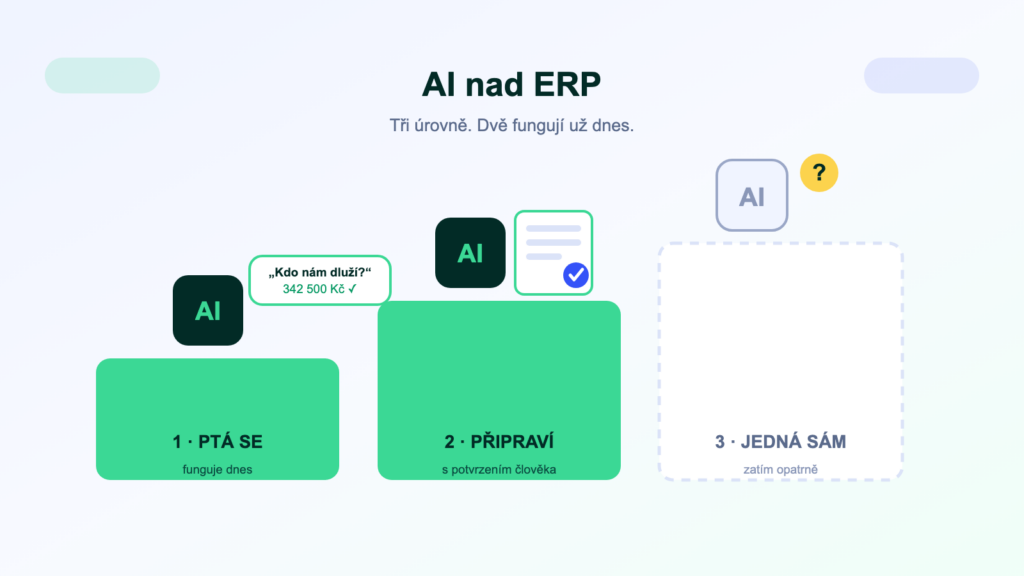
Three levels of AI over business data
AI over an ERP reliably handles the first two levels today: answering questions over live data and preparing actions for a human to approve. The third level — an autonomous agent acting on its own — so far only makes sense for low-risk tasks under supervision.
- It answers. The AI reads live data from the ERP and responds: who owes what, what’s in stock, how revenue is doing. No writing to the data — just fast answers where you used to wait for a report.
- It prepares. The AI drafts a payment reminder, the figures for a VAT return or an order proposal — and a human approves it with one click. The routine disappears, the responsibility stays with people.
- It acts on its own. The agent performs actions without approval. Technically it is already possible; the question is where it is sensible — and for now the answer is: for low-risk, well-bounded tasks.
Level 1: AI that knows your numbers
This is the safest bet today — and for most companies the first real contact with AI over their own data. An assistant (Claude, ChatGPT…) connects to the ERP and answers the questions people used to wait until the next meeting for:
- Money“How is cash flow trending compared with last quarter?” “How much do our ten biggest customers really owe us?”
- Stock“Which items have sat in the warehouse for over a year, and at what value?” “What will we run out of within a fortnight?”
- Sales“Compare margins by product category.” “Which customers bought less this year than last?”
- Operations“What changed last week? Summarise it for Monday’s meeting.”
Technically this is enabled by the MCP standard, which connects AI assistants to business systems — we explain it here. We have connection guides for both ChatGPT and Claude.
Level 2: AI that prepares the work
The second level adds writing — but with a human as the final authority. The AI drafts reminder texts based on actual receivables, puts together the figures for a VAT return, proposes a purchase order based on stock levels. A person reviews and confirms; only then is the action carried out, via the ERP’s official interface with all its validations. This principle even has a name — human in the loop — and it is the most sensible way today to let AI write into your accounts.
Level 3: the autonomous agent
A fully autonomous agent already makes sense where the task is well-bounded and a mistake is cheap: watchdogs and alerts, sorting and matching by clear rules, preparing reports. Unsupervised accounting entries, on the other hand, are still a bad idea — not because it can’t be done technically, but because of three things: hallucinations (a model can be confidently wrong), accountability (who signs off a faulty invoice?) and audit (you must be able to prove who did what and why). Progress is fast; the sensible strategy is to grow level by level, not to jump straight to the third.
Telling marketing from reality: four questions for the vendor
1. Does the AI see our live data, or is it a chatbot trained on documentation? The difference between “tells you where the button is” and “tells you who owes us what”. 2. Is there an audit log of every query and action? 3. What happens on an error — who sees it and how is it fixed? 4. What data leaves the company, where does it flow, and are models trained on it? A serious vendor answers without dodging; a demo with no answers puts you at the level of marketing, not operations.
What this means for your ERP
The good news to finish with: you don’t have to change systems because of AI. Levels 1 and 2 can be built on top of what you already have — POHODA, Money S4/S5, Helios, KARAT and others. The AI layer connects to your existing ERP’s data via an MCP server, starts in read-only mode, and you decide which agendas the AI can see. How it fits into the wider puzzle of business systems is covered in our guide to ERP integrations.
Frequently asked questions
Will an AI agent replace accountants?
No — it moves the routine. Chasing numbers, retyping and preparing figures will shrink; review, decision-making and responsibility stay with people. In practice, AI helps most those accountants who are swamped with questions from sales and management.
Do we need a new “ERP with AI”?
Usually not. An AI layer can be built on top of your existing system via MCP — no migration, no ERP replacement. Swapping systems because of AI is currently the most expensive possible route to a result you can have for a fraction of the price.
What about hallucinations — won’t the AI make numbers up?
At levels 1 and 2, answers rest on figures pulled from the ERP database, not on the model’s memory. Even so, insist that answers can be substantiated — with references to specific documents or records. Where they can’t, treat the output as a draft to be checked.
How do we start?
With a level-one pilot: connect the AI read-only to a few agendas and let the team ask questions for two weeks. Our MCP servers for ERP start at 2 490 Kč per month — details at POHODA MCP and for other systems.
Was this article helpful?
Thanks for the feedback!